Op. Dr. Bekir Can Gümüşlü
Online
×
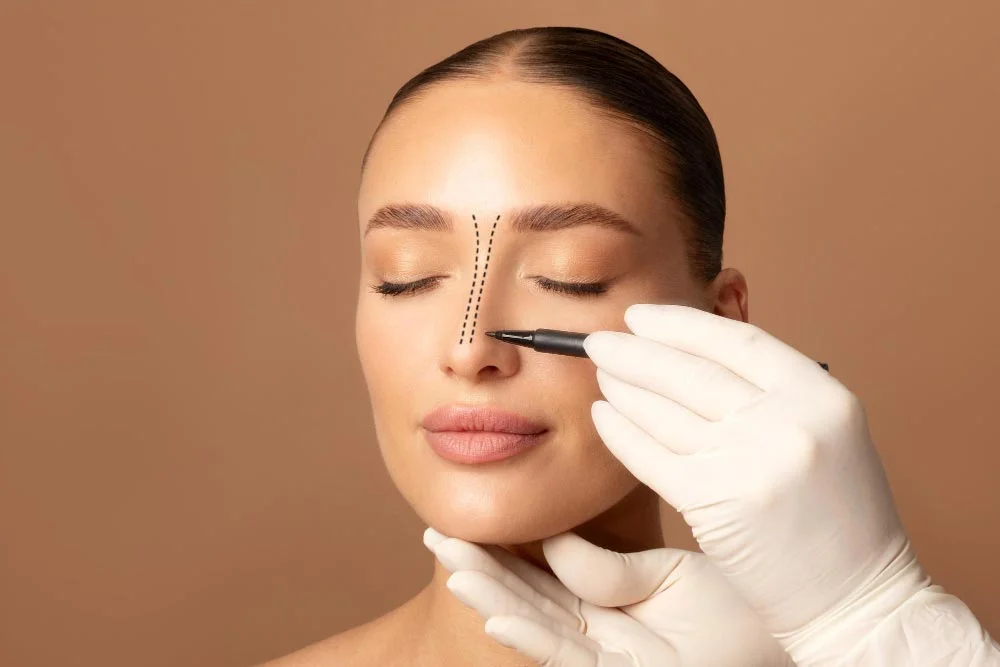
Although trends in aesthetic surgery change over the years, there remains a single unchanging truth: Naturalness. The “slide-like” noses of the 90s, characterized by being excessively upturned, having nostrils visible from the front, and possessing an extremely hollowed-out bridge, are no longer preferred.
In today’s modern understanding of aesthetics, Natural Rhinoplasty, which “does not look operated on” and integrates with the person’s facial features, is at the forefront. Op. Dr. Bekir Can Gümüşlü creates personalized designs for each patient by using the principles of the Golden Ratio, the mathematical balance of the face.
The golden ratio (1.618) is the mathematical proportion most pleasing to the eye in nature, art, and architecture. The more this ratio is preserved in the human face, the more attractive and aesthetic the person is perceived to be. When performing golden ratio analysis in rhinoplasty, the following parameters are evaluated:
The angle the nose makes with the forehead determines the softness of the profile view.
Ideally, this should be between 95-105 degrees for women and 90-95 degrees for men. An excessive increase in this angle leads to a “pig nose” appearance, while a decrease leads to a “droopy nose” appearance.
When the face is divided horizontally into three (forehead, nose, chin), the goal is for the area occupied by the nose to be equal to the other regions.
Op. Dr. Bekir Can Gümüşlü performs digital simulations on professional photographs taken before the surgery to show you how your new nose will fit these proportions.
For a nose to be considered “natural,” it must meet these three conditions:
A natural nose is, above all, a nose that breathes comfortably. Breathing channels must not be narrowed for the sake of aesthetics.
A nose may be beautiful on its own, but if it is too large or too small for your face, it is not natural. For example, creating a very thin and small nose for someone with a wide face will look artificial.
Light refractions on a natural nasal bridge should be soft; there should be no sharp lines that look as if they were pinched with a clothespin.
The nose of a celebrity you see on the internet may not create the same effect on your face. This is because everyone’s skin thickness, cartilage strength, jaw structure, and cheekbone prominence are different. Personalized rhinoplasty is planning carried out by taking these variables into account. Instead of “Copy-Paste” noses, Op. Dr. Bekir Can Gümüşlü designs unique noses that reflect your character.
No. A natural nose does not mean a ‘minimally altered’ nose. Sometimes radical changes are made to a very large, arched nose, but the result is so harmonious that the person appears to have been born that way.
Of course. In male patients or women who desire a natural appearance, very stylish results can be achieved by simply straightening the bridge without excessively lifting the tip of the nose (without rotation).
Simulations provide an idea that is 90-95 per cent accurate. However, as the operation is performed on living tissue, there may be millimetre-level differences depending on the healing process and skin structure.
Yes, but thick skin can mask the lines. On thick-skinned noses, a ‘natural and slightly larger’ nose looks much more aesthetically pleasing than an ‘excessively reduced and shapeless’ one.
Depending on the scope of the procedure, it takes between 2 and 3.5 hours.